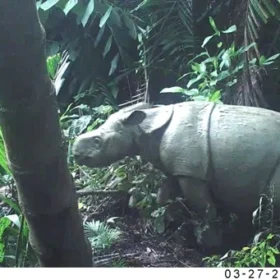
3 New Javan Rhino Calves Discovered. Ujung Kulon National Park has recently confirmed the presence of three new Javan rhino calves (Rhinoceros sondaicus), thanks to a combination of footprint tracking and camera trap footage.

The discovery was announced by Satyawan Pudyatmoko, Director General of Natural Resources and Ecosystem Conservation (KSDAE) at the Ministry of Environment and Forestry, who credited the success to a “fully protected area system.” This system includes restricting human access to the Ujung Kulon peninsula, creating a safe haven for these critically endangered animals.
“Consistent conservation efforts are vital to preventing the extinction of the Javan rhino,” Satyawan emphasized in a statement issued on Saturday, May 3, 2025.
The first calf, a female estimated to be just over two years old, was spotted on March 30, 2025, in the southern region of the peninsula. Captured on camera, the Javan rhino calve was seen walking closely beside her mother, mirroring her appearance and behavior.
Just a few days later, on April 3, a second calf—a young male Javan rhino calve estimated to be under three years old—was recorded in the same area. While a small horn is already visible, researchers are still assessing his overall health and development.
The third and youngest Javan rhino calve was not caught on camera but identified by its footprints on April 20 in one of the park’s key rhino concentration zones. The footprints, measuring around 19–20 centimeters, suggest the calf is between four and six months old.
Satyawan noted that these findings highlight the effectiveness of the park’s “Spatially Explicit Model” monitoring system. The setup includes 35 clusters of camera traps, with four cameras in each cluster, allowing for more precise tracking of the elusive rhinos.
Javan rhinos are among the rarest large mammals on Earth and are strictly protected under Indonesian law (Ministerial Regulation No. P.106/MENLHK/SETJEN/KUM.1/12/2018). They are also listed as “critically endangered” by the International Union for Conservation of Nature (IUCN), facing a high risk of extinction in the wild.